

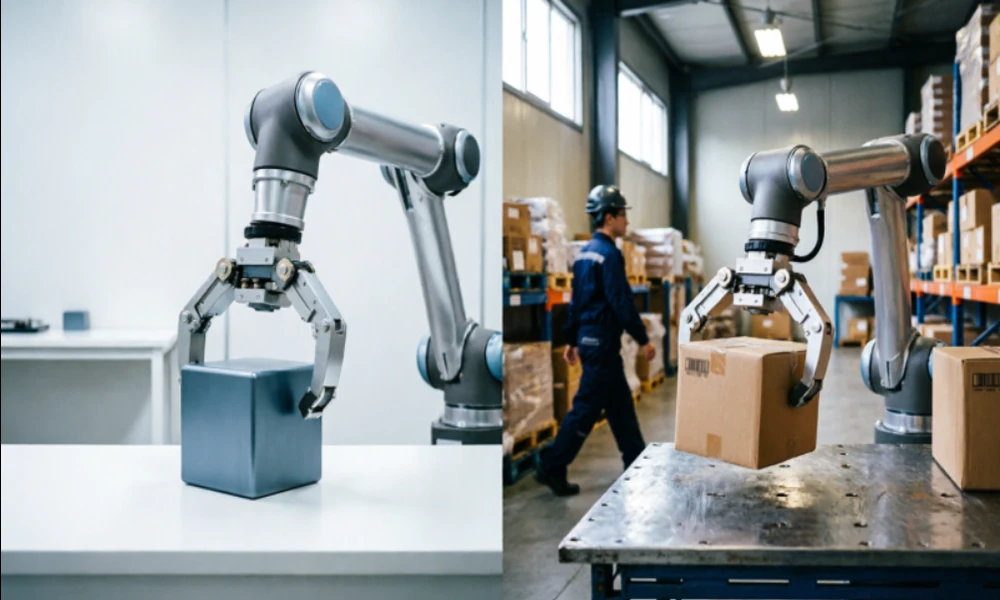
Physical AI is artificial intelligence that senses the real world, reasons about it, and acts in it through robots, vehicles, and machines. That is the textbook answer. The answer that matters to your budget is different. Physical AI is only as real as its behavior outside the lab, and most systems ace the demo then stall on the factory floor. This guide defines the term the way operators do, shows exactly where demo systems break, and explains what closes the gap.
What is physical AI?
Physical AI is artificial intelligence that perceives the physical world through sensors, reasons about what it perceives, and takes physical action through robots, vehicles, and machines. Generative AI produces content. Physical AI produces behavior. And you should measure that behavior in deployment, not in a demo.
Every robotics buyer knows the video. A humanoid folds a shirt in one smooth motion. The lighting is perfect. The table is clean. The shirt is cotton, medium sized, and suspiciously well behaved. Then the same robot meets a real laundry pile in a real home and freezes like it saw a ghost.
That gap has a price tag. Mordor Intelligence puts the physical AI market at USD 7.11 billion in 2026, headed to USD 34.89 billion by 2031. Money is flooding into the category. But money follows demos, and revenue follows deployments. Those are different things.
This post answers what physical AI is in plain terms. Then it does the more useful work. It shows you why demos flatter these systems, where they break in the field, and what separates the ones that ship from the ones that stall. If you plan to evaluate a physical AI system this year, read the deployment section before you watch another demo reel.
What Is Physical AI, In Plain Terms
Physical AI is AI that runs a loop with the real world. It senses through cameras, microphones, LiDAR, force sensors, and inertial units. It reasons about what those sensors report. Then it acts through motors, grippers, wheels, and arms. Sense, reason, act. Repeat, many times per second.
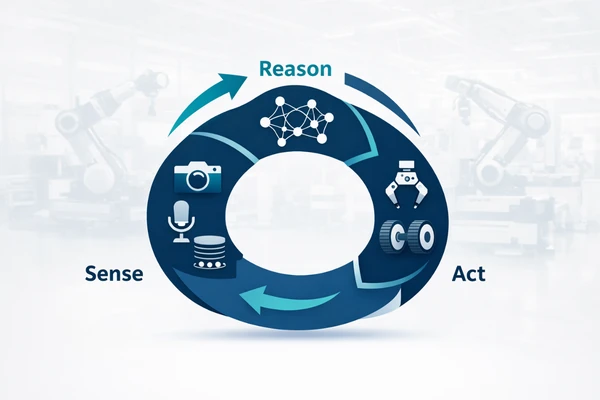
The category covers robots, autonomous vehicles, drones, warehouse systems, and industrial machines. It does not cover chatbots. It does not cover a vision model that labels photos and stops there. Here is a simple test you can use in any vendor meeting. Remove the AI model from the machine. If the machine stops moving or stops adapting, you are looking at physical AI. If nothing physical changes, you are not.
One more thing deserves a plain statement. Physical AI systems deal with physics. Friction, weight, timing, contact, uncertainty. Software AI gets to be wrong quietly. Physical AI gets to be wrong in front of a forklift.
Physical AI vs Generative AI vs Embodied AI
People mix these three terms daily, so here is the clean split.
Generative AI creates content. Text, images, code, audio. It lives behind a screen, and its mistakes cost you an edit.
Physical AI creates behavior. Movement, grasping, navigation, inspection. Its mistakes cost you product, downtime, or a safety incident.
Embodied AI is the research community’s term for intelligence that lives in a body and learns through physical interaction. Industry uses physical AI as the broader umbrella covering the full stack of sensors, models, and machines. The Humyn Labs guide to embodied AI goes deep on how these models ground language in action. For most buyers the practical takeaway is short. The labels overlap. The deployment record does not.
Why the Demo Almost Always Works
Here is an uncomfortable truth from watching this industry closely. The demo is not lying to you. It is answering a much easier question.
A demo is a closed world. The lighting is controlled. The objects are rehearsed. The table height never changes. The run you watch is often the best of forty takes. None of that is fraud. It is how every lab shows progress. But a closed world is exactly what your facility is not.
Benchmarks carry the same problem. A model tuned to score well on a benchmark learns the test, not the environment. World models help systems predict physical outcomes before acting, and this explainer on how world models simulate reality covers why that matters. But prediction trained on narrow data predicts a narrow world.
So the demo works because the demo world is small. Your world is not. That single sentence explains most physical AI disappointment, and the next section breaks it into parts you can actually inspect.
Where Physical AI Breaks Between Demo and Deployment
The sim to real gap
Simulators teach clean physics. Perfect friction values, ideal lighting, sensors without noise. A policy that behaves in simulation then meets real glare, real dust, and a slightly wet floor, and it drops the cup. Teams that treat this as an algorithm problem keep stalling. It is mostly a data problem, and the breakdown of robotics training data from simulation to real world shows why the fix starts with the dataset, not the model.
Long tail variation
The physical world contains an effectively infinite spread of objects and conditions. Shapes, weights, textures, deformation, clutter. A gripper trained on rigid plastic bottles fails on a wet glass or a soft bag of rice. Manipulation is where this bites hardest, which is why robot manipulation is still called the hardest unsolved problem in embodied AI.
Contact physics
The moment a gripper touches an object, physics turns nonlinear. Tiny changes in contact point or approach angle change the outcome completely. No simulator rehearses every contact case. Only broad real world data comes close.
The root cause under all three
The training data never contained the mess. Models trained on clean, staged, third person footage enter a first person world full of glare, clutter, and surprise. The gap between demo and deployment is mostly the gap between the data a model saw and the world it walked into. That is the honest answer to what is physical AI failure. It is a data distribution failure wearing a robot costume.

How the Gap Gets Closed
Three practices separate deployment grade physical AI from demo grade.
First, the real world and source first data. Egocentric video captures tasks from the demonstrator’s own viewpoint, which matches what a robot’s onboard camera will actually see. The practical guide to robot learning from human demonstration explains why first person data has become the most scalable training format for robot foundation models. This is also where Humyn Labs works. The company runs the full egocentric, source-first data pipeline-sourcing, validation, multi-layer QC, annotation, and human-in-the-loop review-across commercial, agricultural, and residential environments across the Global South and other emerging deployment markets, and committed USD 20 million in 2026 to scale those operations, including voice data across 33 languages so robots can take human instructions with real cultural context.
Second, multimodal capture. Vision alone misses half the task. Deployment grade physical AI training data pairs egocentric video with audio, force, movement, and multi view recording, so the model learns the full sensory picture of a task instead of a silent film version of it.
Third, evaluation against deployment conditions instead of benchmarks. Test on your objects, your lighting, your floor. Humyn Labs built BRIDGE for exactly this reason, to evaluate models against real world conditions rather than saturated benchmark suites.
Before you sign with any physical AI vendor or data partner, ask four questions. Where was the training data collected, and does it resemble my environment? What share of it is real world versus synthetic? How was it verified and annotated? And what happens when the system meets an object it has never seen? Vendors with deployment grade answers welcome these questions. The other kind changes the subject back to the demo.
What Businesses Gain From Deployment Grade Physical AI
For industrial operators, the returns are concrete. Physical AI that survives deployment addresses labor shortages, cuts downtime, reduces quality losses, and takes people out of hazardous tasks. Every one of those maps to a line in your P&L, not to a vision statement.
For builders, the gain is speed. Data that reflects the target environment shortens iteration cycles because failures show up in training instead of in the field. Curated datasets built from real environments compress the distance between pilot and production revenue, which is the only distance that matters once funding depends on shipped systems.
And for both sides, deployment grade systems buy trust. A robot that works on day one in a customer facility sells the next ten robots. A robot that freezes sells a refund.
FAQ
Is physical AI the same as robotics?
No. Robotics builds machines that move, and for decades those machines ran on fixed programming. Physical AI adds learned intelligence, so the machine senses its environment, adapts to change, and improves with data. Every physical AI system involves robotics hardware, but not every robot carries physical AI.
What data does physical AI need to work in the real world?
It needs real world, multimodal training data. Egocentric video of humans performing tasks, multi view recordings, force and movement signals, and audio, all collected across varied environments. Models trained only on simulation or staged footage fail on real variation, which is why source first collection matters.
Why do physical AI demos fail in production?
Demos run in closed worlds with controlled lighting, rehearsed objects, and selected takes. Production runs in open worlds full of variation the training data never covered. The failure is a data distribution gap, not usually a hardware fault, and it closes with broader real world data.
How big is the physical AI market?
Mordor Intelligence values the physical AI market at USD 7.11 billion in 2026 and projects USD 34.89 billion by 2031. Growth is driven by humanoid robotics investment, autonomous systems, and rising demand for real world training data across industries.
How do you evaluate a physical AI system before buying?
Test it in your environment, on your objects, under your lighting. Ask where the training data came from and how much of it was real world. Structured evaluation helps here, and Humyn Labs runs BRIDGE evaluations against real deployment conditions so buyers see behavior, not benchmark scores.
The Definition That Should Guide Your Budget
So, what is physical AI? On paper, it is AI that senses, reasons, and acts in the physical world. In practice, it is the machine that still works when the shirt is wrinkled, the light is bad, and nobody rehearsed the scene. Hold every vendor, every model, and every dataset to that second definition. Demos are marketing. Deployments are the product.
If you build these systems, the shortest path from demo to deployment runs through data that looks like your deployment. Talk to Humyn Labs about its full physical AI data pipeline, and put your next demo in front of the real world with confidence.
