

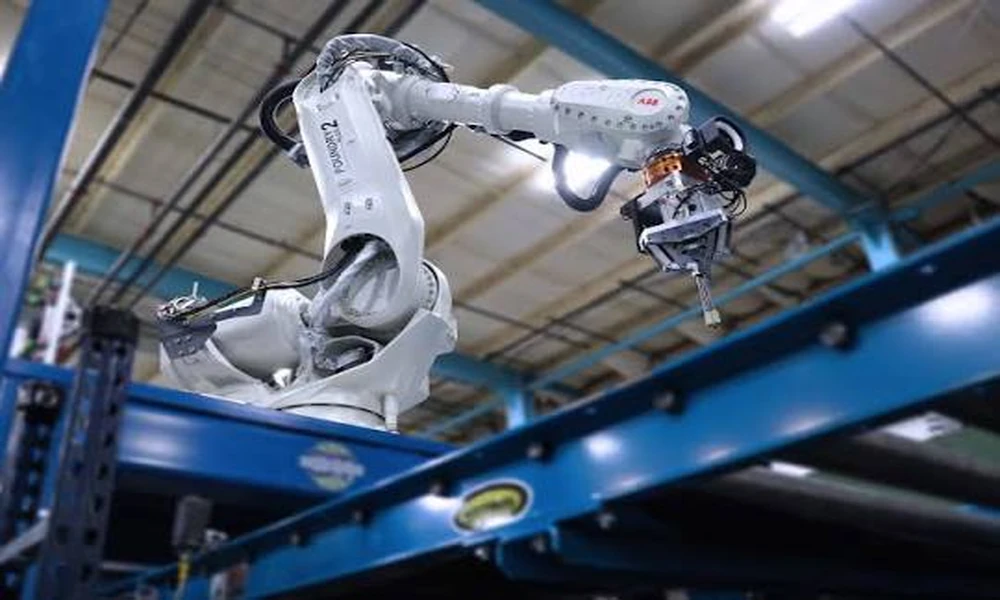
Industrial robots are usually compared by reach, payload and speed. These specifications describe how the robot can move, but they do not determine what the machine can actually do with a product. That depends largely on the equipment attached to the wrist.
End-of-arm tooling, commonly shortened to EOAT, includes the grippers, process tools and sensors that interact directly with the workpiece. Selecting this equipment correctly is one of the most important steps in designing a reliable robotic application.
EOAT covers much more than grippers
The phrase end of arm tooling for robots is often associated with simple mechanical grippers, but the category is much broader. Vacuum tools, magnetic grippers, screwdrivers, sanding systems and sensors can all operate at the end of a robot arm.
OnRobot’s current portfolio provides a useful illustration of that variety, including finger, vacuum, magnetic and adhesive grippers as well as force/torque sensing, screwdriving and sanding equipment. Each technology solves a different physical problem, which is why tool selection should always begin with the application.
A manufacturer handling cardboard boxes has different requirements from one loading oily metal components into a machine tool.
The workpiece determines the gripping strategy
Weight is the obvious parameter, but it is only the beginning. Engineers also need to consider shape, surface texture, stiffness and how consistently the product arrives at the robot.
Vacuum works well when the surface provides an adequate seal. Parallel fingers are useful when the part has predictable contact areas, while magnetic gripping is limited to suitable materials. Irregular or delicate objects may require compliant contact rather than rigid fingertips.
The strongest gripping method is not automatically the best. Applying excessive force can damage a product, while a heavier end effector reduces the payload available for the workpiece itself.
Tool weight changes the robot calculation
Robot payload ratings apply to the complete load carried at the wrist. This includes the end effector, mounting hardware, sensors and the part being handled.
A robot rated for a particular payload therefore cannot necessarily lift a workpiece of that same weight once a substantial gripper has been installed. The centre of gravity also matters because a long tool or extended fingertips create different loads than a compact object located close to the flange.
These calculations should be completed early in the project. Discovering after installation that the chosen tooling reduces usable payload too far can require an expensive redesign.
Sensors should solve a real problem
Force sensing and vision can make a robotic cell more adaptable, but adding technology for its own sake is rarely useful. A sensor should compensate for a specific source of variation.
Force/torque sensing is valuable when the process depends on controlled contact, such as some insertion or finishing operations. Vision can help when workpieces arrive in varying positions. If parts are already located accurately in a fixture, additional sensing may simply add cost and complexity without improving the process.
The same principle applies throughout automation: use feedback where uncertainty exists and keep the system simple where the process is already controlled.
Maintenance belongs in the tooling decision
EOAT operates directly in the production environment and can experience significant wear. Vacuum cups deteriorate, fingers become damaged, abrasives need replacement and mechanisms can collect contamination.
It is therefore worth checking not only how a tool performs when new, but how easily wear components can be inspected and replaced. Spare-part availability and maintenance access can affect downtime over the life of the cell.
The robot arm may be the most visible part of an automation project, but tooling is where the machine meets the real world. A well-selected end effector turns robot motion into a useful process; the wrong one can make an otherwise capable robot unreliable.
